Choosing a Disney cruise stateroom
Explore official room renderings and ship-specific sizes, beds, bathrooms and views before comparing your cabin options.
Choose the least expensive confirmed room arrangement that meets your needs, then decide whether an upgrade adds enough daily value. Category names alone cannot confirm occupancy or accessibility.
Picture your room, morning to bedtime.
Explore large official interior images, sleeping setups and floor plans. Then compare the beds, bath and space your family will use. Gallery images represent a category; décor, accessible layouts and individual rooms can differ.
Disney Wish · Verandah · 2 category examples
Private outdoor space can be useful during downtime. Published areas include the balcony. On Adventure, garden and reef-facing balconies are different from an ocean view.
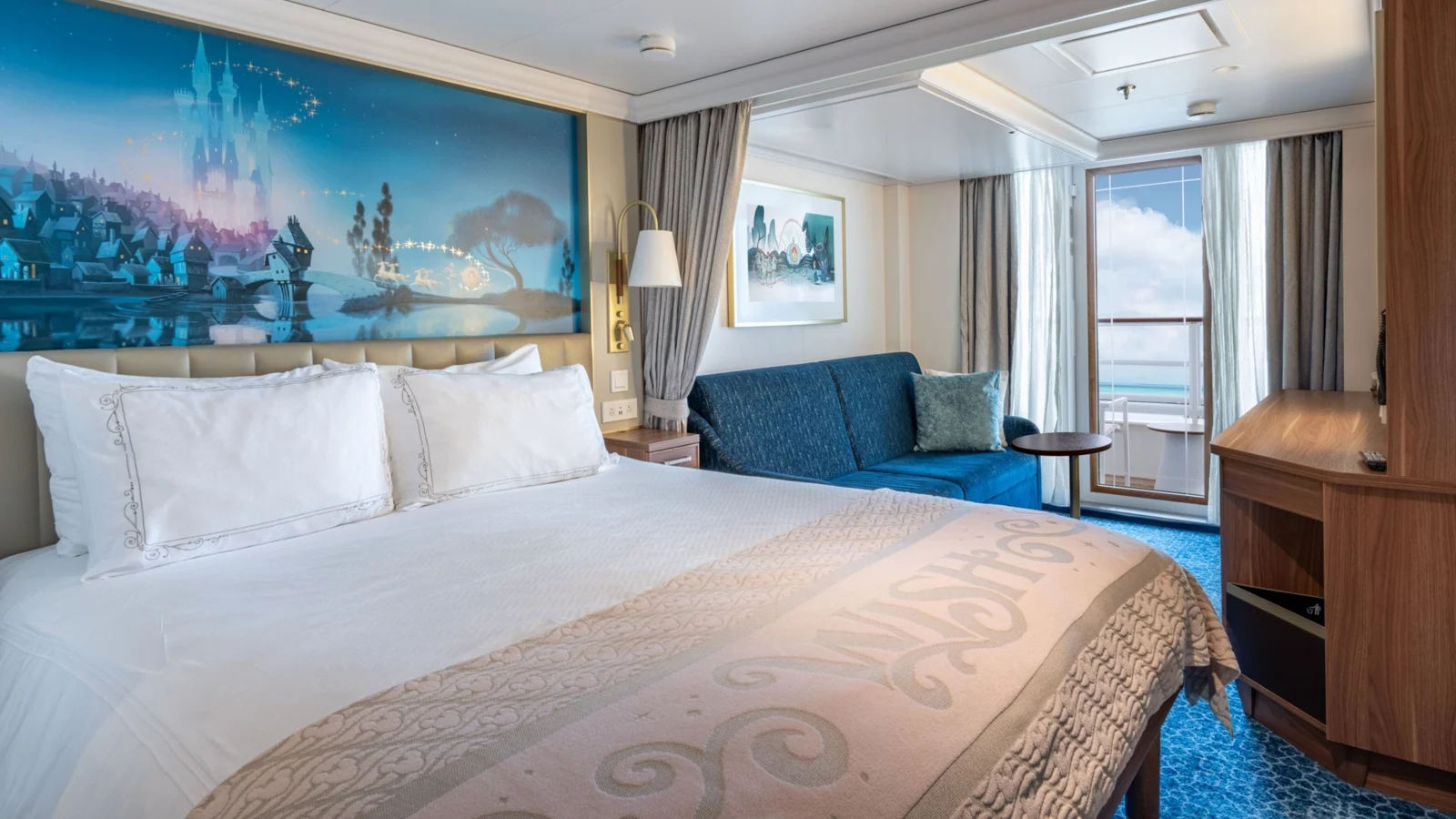 View larger ↗
Deluxe Oceanview with Verandah Stateroom
- Area
- Approx. 243 sq ft including balcony
- Sleeps
- 3 to 4 Guests
- Beds
- Queen plus single sofa; upper berth in four-person cabins
- Bathroom
- Split bath; shower and toilet in separate compartments.
- View
- Private Balcony
243 sq ft is the published individual-cabin figure used here; Disney’s general category page contains a different area. Confirm your exact room.
Capacity varies by room. A maximum does not guarantee that every cabin in this category fits that many guests.
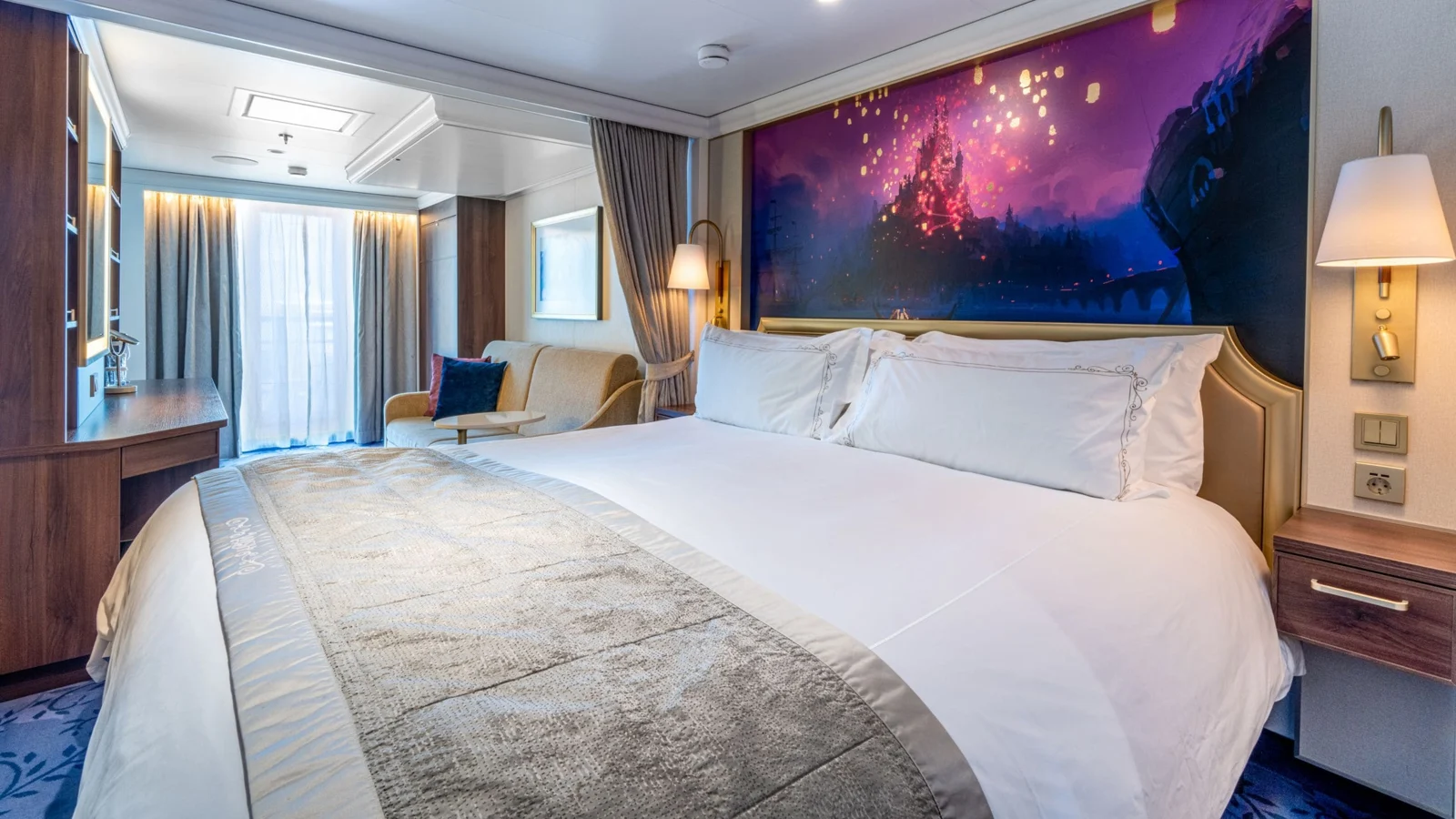 View larger ↗
Deluxe Family Oceanview with Verandah Stateroom
- Area
- Up to 284 sq ft, including balcony
- Sleeps
- Up to 5 Guests
- Beds
- Queen, single sofa, and additional pull-down beds according to occupancy
- Bathroom
- Split bath; shower and toilet in separate compartments.
- View
- Private Balcony
Capacity varies by room. A maximum does not guarantee that every cabin in this category fits that many guests.
What the rendering and square footage do not tell you
- After bedtime: locate every pull-down or sofa bed when open, check any ladder, and make sure the bathroom route still works. A curtain is not a separate bedroom.
- Connecting rooms: book a confirmed internal-door pair. Adjacent cabins do not necessarily connect; compare the cost and supervision arrangement with one larger room.
- Balcony views: check obstructions, rail style and whether the view faces the sea or an onboard area. Keep children supervised.
- Location: look at decks above and below for pools, entertainment and service areas. Compare repeated walks to meals, clubs and lifts.
- Accessibility: use the exact room’s dimensions, doorway, bathroom and transfer details. Standard renderings and the split-bath labels here do not describe an accessible layout.
Disney’s accessible-room specifications ↗ · Official deck plans ↗
All official Disney Wish categories, photos and suites ↗ · Compare your family’s cabin needs →
References
Specifications checked October 13, 2026. Areas are Disney’s published approximate category figures; ranges can include unusual layouts. Verify the selected room number and sailing before paying.
Open a topic for the details
Do not carry a cabin-size assumption from one ship to another
The published examples below describe category groups, not a room guarantee. Compare these with the Dream examples further down, then open the exact ship, category and room number before paying. A group’s maximum occupancy does not mean every room in that group takes that many guests.
| Ship / category group | Published capacity | Published area |
|---|---|---|
| Disney Wish / inside | 3–4 guests | 169 sq ft |
| Disney Wonder / inside | 3–4 guests | 184–214 sq ft |
| Disney Wonder / deluxe oceanview | 3–4 guests | 214 sq ft |
Ask for the night-time layout
Before choosing, confirm which guest uses each bed, how the room works when every bed is open, the bathroom arrangement and any mobility-related clearances. For two cabins, distinguish connecting doors from rooms that are merely adjacent. If a particular bed or accessible feature determines whether the trip works, verify it for the actual cabin rather than relying on a category photo.
A concrete cabin example: Disney Dream
These are Disney’s published category-group ranges, checked October 9, 2026. A range covers several room types; it does not mean every cabin in the group sleeps the maximum. Confirm the exact category and number.
| Category group | Published occupancy / area | Decision to make |
|---|---|---|
| Inside | 3–4 guests; 169–204 sq ft; virtual porthole. | Compare when outdoor space is not a priority. A virtual view does not provide natural daylight. |
| Deluxe oceanview | 3–5 guests; 204–241 sq ft; real porthole. | Compare for daylight; verify that your exact room accommodates everyone. |
| Oceanview with verandah | 3–5 guests; 246–299 sq ft including balcony. | Compare when private outdoor time matters; balcony area is included in the total. |
One family cabin versus two connecting cabins
Illustrative comparison: an eligible five-person cabin quoted at US$6,000 versus two confirmed connecting cabins totalling US$6,800 creates an US$800 premium. For four nights that is US$200 per night for the additional room arrangement. Compare sleeping privacy, bathrooms and supervision, and confirm booking/occupancy rules for children. Two adjacent rooms do not establish an internal connecting door; no availability is implied by this example.
Make a bedtime layout before booking
Draw where every person sleeps after the sofa or pull-down beds are opened, where a cot would go if needed, and how someone reaches the bathroom. Ask whether a sleeping space uses a ladder and whether curtains or a true door separate sleepers. Use official room photos and deck plans; do not transfer Dream’s ranges to another ship or treat a category name as an identical floor plan.
Begin with the sleeping arrangement
Count separate beds or sleeping surfaces, not just people. Ask how the cabin is arranged at night and whether a berth or sofa is appropriate for each guest. For two cabins, confirm the actual connecting arrangement and booking requirements; adjacent rooms are not necessarily connecting rooms.
Compare daylight and outdoor space
An interior room may suit a family that mainly sleeps in the cabin. An oceanview option can provide daylight without a private balcony, while a verandah may appeal if someone expects to spend substantial quiet time in the room. Verify the exact view, obstruction and balcony design before assigning value.
Look around the room on the deck plan
Check what is above, below and beside the cabin and where the family will walk repeatedly. If motion sensitivity or sleep disturbance is a concern, discuss your needs directly with the booking team and an appropriate clinician where relevant. No cabin location guarantees freedom from motion or noise.
Price the actual upgrade
Compare the complete cabin offers for the same sailing and party. Divide the difference by nights if that helps judge the daily value. Include changes to gratuities and other included benefits when comparing Concierge; do not assume premium service removes availability limits.
Confirm before paying
Verify occupancy, beds, bathrooms, access features and any room-assignment restrictions in writing. Our decision helper describes what to investigate and does not reserve a cabin, inspect live inventory or certify a room as suitable.
Your next steps
- Confirm actual beds and occupancy.
- Check view and balcony details.
- Inspect the deck location.
- Verify accessibility and connecting-room requirements directly.
Use this with your own plans
Find cabin categories and sleeping arrangements to compare, with clear reasons, tradeoffs and checks for your light, balcony and room requirements.
Disney cruise cabin decision helperReferences
Only the claims described below were checked. Planning recommendations are Sunday & Wonder editorial guidance. Prices, schedules and availability require confirmation for your dates.
Staterooms by ship
Reference
Review due · 2026-10-09
Official directory links ship-specific stateroom categories. Disney Dream category-group examples are separately sourced; individual room layouts, occupancy and connecting doors still require confirmation.
View source ↗Cruise guest services
Reference
Review due · 2026-10-09
Entry points for accessible staterooms and travel information. This does not verify personal documentation or accessibility suitability.
View source ↗Disney Cruise Line gratuities
Reference
Review due · 2026-10-09
Recommended nightly gratuities: US$16 per Guest, including children and infants; US$27.25 for Concierge. Extra-service gratuities are separate.
View source ↗Disney Wish room categories
Reference
Review due · 2026-10-09
Inside category-group capacity and floor area; these are not guarantees for a particular room number.
View source ↗Disney Wonder room categories
Reference
Review due · 2026-10-09
Inside and oceanview category-group capacity and floor area; verify the exact selected cabin.
View source ↗Disney Dream room categories and dimensions
Reference
Review due · 2026-10-09
Category-group occupancy and area ranges, inside virtual porthole, oceanview window and verandah. Ranges do not establish capacity of an individual cabin.
View source ↗Disney Dream interactive deck plan
Reference
Review due · 2026-10-09
Official room-number and deck navigation; the site warns categories can change with enhancements. No individual connection or noise guarantee.
View source ↗Disney Cruise Line
Choose a Disney cruise stateroom: beds, space and daily routes
Choose a Disney cruise stateroom by checking where everyone will sleep, how the room works after the beds are prepared and how its location fits your daily routes. A room category name is a starting point, not a complete description of family comfort.
AI-assisted research and editorial review. How we prepare these guides
Choose a Disney cruise stateroom by checking where everyone will sleep, how the room works after the beds are prepared and how its location fits your daily routes. A room category name is a starting point, not a complete description of family comfort.
Before comparing views, list the non-negotiables: enough approved occupancy, suitable sleeping places, any required accessibility features and a price you can afford. Then compare the benefits you would actually use, such as daylight, an outdoor space or a more convenient location.
Make a bed assignment before booking
Write each traveller’s name beside a proposed sleeping place. Check the exact ship, category and available room details rather than assuming every room in a broad category has the same arrangement. Do not treat a photograph of an attractive daytime sofa as proof of the nighttime layout.
Disney’s Dream stateroom overview, for example, describes different accommodation categories and guest capacities, and notes family-oriented features such as split bathrooms in many rooms. That is information about the Dream; it is not evidence that another ship has identical rooms. Disney Dream staterooms
Ask directly about any unclear detail: whether the proposed room has the required bed configuration, whether the main bed arrangement meets your needs and how an additional berth is accessed. Do not resolve uncertainty by assuming a child will “fit somewhere.” The booked occupancy and confirmed sleeping arrangement come first.
Draw the room at bedtime
A simple sketch can reveal more than a list of amenities. Mark the door, bathroom access, sleeping places and where you expect luggage or a stroller to go. Then imagine one person getting up while another is asleep.
Use three household scenarios: a child goes to bed before the adults; everyone needs to get ready for dinner; and the family returns with wet clothing. Ask which tasks can happen at the same time and which require someone to wait or move.
A privacy curtain, if present in your chosen room, may help separate activities visually. It should not be assumed to function like a separate bedroom. If adults expect to talk or watch something while a child sleeps, discuss whether the actual layout supports that expectation.
Read measurements carefully
When a room size includes a balcony or verandah, that number does not represent entirely indoor living space. Disney’s Dream overview explicitly labels its verandah measurements as including the balcony. Compare like with like before deciding that one category offers substantially more room for beds and luggage. Dream room categories and measurements
Also distinguish the capacity of a category from the capacity of the particular room offered. A range shown on an overview needs to be resolved against the actual party and booking. If the listing says “up to” a number of guests, that wording alone does not explain which beds are in your selected stateroom.
For an accessibility requirement, describe the task or equipment precisely and obtain room-specific information from Disney. A general accessible-room symbol cannot answer every question about transfers, storage, bathroom layout or the route to other venues.
Evaluate location as a daily route
Use the official deck plan for the ship and the relevant configuration. Find the stateroom, then trace routes to the places your family expects to use frequently. Disney’s deck-plan tool separates ships and notes that some room categories may differ because of enhancements. Disney Cruise Line deck plans
A family planning frequent youth-club visits might value a convenient route to those spaces. Another may care more about dining or the route back from evening entertainment. There is no need to call one location best for everyone.
Check what is above, below and beside the room, while recognising that a plan cannot promise a particular noise level. If a location raises a concern, ask a specific question. “Is this a quiet room?” is less useful than identifying the adjacent venue and asking about its activity.
Keep motion questions separate from room promises
If motion is a major concern, ask Disney about the available locations and consult an appropriate clinician about your individual health questions before travel. Do not choose a stateroom on the promise that a particular deck or position will prevent symptoms.
You can still make a practical comparison: the route to open areas, access to a preferred place to rest and whether the room is within budget. Investigate those practical details while keeping health decisions with your clinician; a room description cannot guarantee how you will feel at sea.
Compare one room with two only on a fair basis
A hypothetical family of five considers a room that accommodates everyone and two rooms with a confirmed connecting arrangement. They compare the total fare for the same sailing, the actual beds, bathrooms, supervision plan and room-assignment requirements.
Two rooms may create useful space, but “nearby” and “connecting” are different descriptions. Do not assume an internal door exists unless it is confirmed. Equally, a larger single room should be evaluated at bedtime, not only through its daytime photograph.
Ask whether each arrangement still works if someone sleeps early or needs quiet time. Then weigh the improvement against the whole-trip budget. An upgrade that makes the room easier to use can be worthwhile; one that removes the funds needed for a manageable arrival may be a poor trade.
Before confirming, save a short room brief: ship, category, occupancy, sleeping plan, essential features and unresolved questions. Once the important questions have answers, you can choose a view or theme for enjoyment without asking it to solve practical problems it was never designed to fix.
Sources and checks
Editorial review 26 October 2026. Each source’s most recent check is listed below. The examples and decision aids are editorial suggestions; labelled hypothetical figures are not current prices or promised timings.
- Disney Dream stateroom overview
Ship-specific categories, capacities, many split bathrooms, and size measurements including balconies.
Checked .
Checked using indexed official-source information.
- Disney Cruise Line deck plans
Ship-specific room/venue deck plans; enhancement caveat.
Checked .
Checked using indexed official-source information.
Planning together? Send the guide to your travel partner. Only the public resource and a general sharing label are included.
Use the first Disney cruise guide. Explore the Sunday email launch list; weekly email delivery is being prepared.